The unboxing journey: from delivery to first program
Six months of observational research at Universal Robots on how first-time customers unbox, mount and start a cobot, mapped into a 12-touchpoint journey with prioritised insights and a threefold concept.
In short
Universal Robots had no data on what happens between delivery and first use of a cobot. Over six months I observed first-time users unboxing, mounting and starting the UR3e and UR5e, and mapped the journey touchpoint by touchpoint.
The result: a 12-touchpoint journey map with prioritised insights, three personas and a threefold concept for a new unboxing experience, plus the usability-test plan to validate it.
The challenge
Cobots are sold on easy deployment, yet the first physical experience, the box, had never been researched. Requirements had shifted since 2015 and the manual still addressed integrators, not the end customer unboxing alone.
- No data on the unboxing journey or its friction points
- Cardboard and foam complaints, internally and from customers
- Manual written for integrators, not semi-independent customers
- 74% of whole-robot service cases depend on the customer keeping the box
Universal Robots needed a solution that could:
- Document the current journey objectively, touchpoint by touchpoint
- Find where friction actually occurs, not where we assumed it did
- Turn observations into prioritised, structured insights
- Develop a holistic concept that works online, offline and on the floor
From an unobserved box to a prioritised journey
Two phases of observational experiments: internal test users across sales, marketing and R&D, then external users with technical and non-technical backgrounds. Each was given a realistic scenario and task, thinking aloud while unboxing, mounting and programming, recorded from three angles. Expert interviews and MyUR case data added the internal and service perspective.
Patterns were clustered into structured insights, prioritised MoSCoW-style and placed on a UXPressia journey map with the emotional state at each touchpoint. Three personas framed the concept: a quickstart guide in physical form, a QR code to a landing page, and an AR option, tested for desirability and planned for usability testing in cycles of five.
Key value drivers
- First evidence base for the unboxing journey
- Friction ranked by impact and cost
- Concept covering online, offline and floor scenarios
- Internal storage problem addressed with the customer's
Tasks solved by the research
- Observational experiments in two phases
- 12-touchpoint journey map with emotion curve
- Personas and threefold concept
- Usability-test plan
Challenges solved
- Assumption-led box feedback
- Integrator-only manual
- Hidden connection and mounting information
- No baseline to measure a redesign against
What changed.
- 12
- Touchpoints mapped, delivery to first program
- 2
- Test phases, internal then external
- 11 / 14
- Internal test users found box information insufficient
- 3
- Personas: Online_floor, Online_offsite, Offline
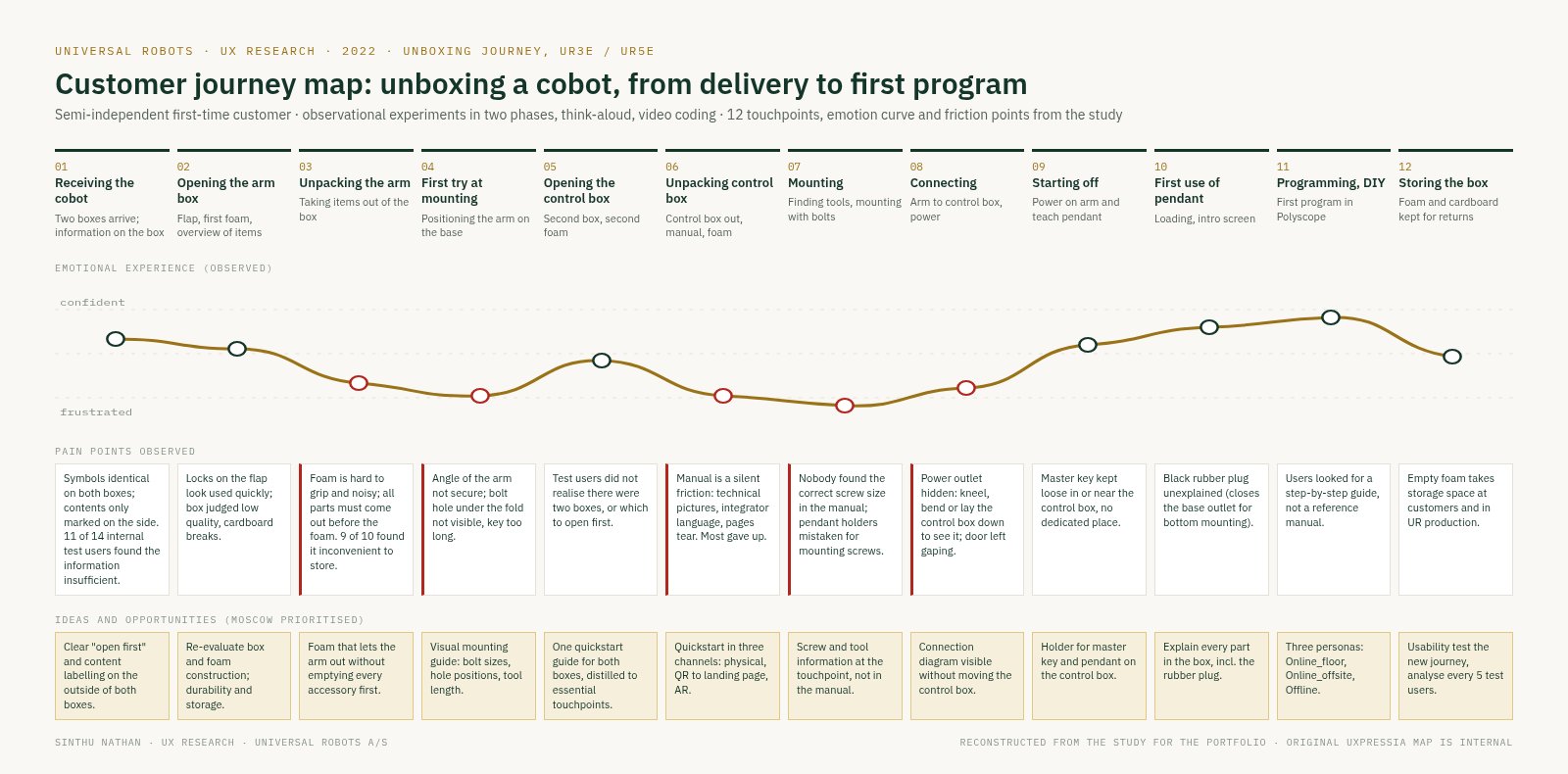
- ↳12-touchpoint customer journey map with emotion curve, pain points and opportunities per touchpoint.
- ↳Insights prioritised MoSCoW-style: foam, manual, mounting and power connection as the urgent friction.
- ↳Three personas (Online_floor, Online_offsite, Offline) and a threefold concept: quickstart guide, QR landing page, AR.
- ↳Usability-test plan for the new journey, analysing and adjusting after every five test users.
The instruments behind the findings.
Twelve touchpoints from receiving the boxes to the first program, with the observed emotion curve, pain points and MoSCoW-prioritised opportunities. Reconstructed from the study for the portfolio; the original UXPressia map is internal.
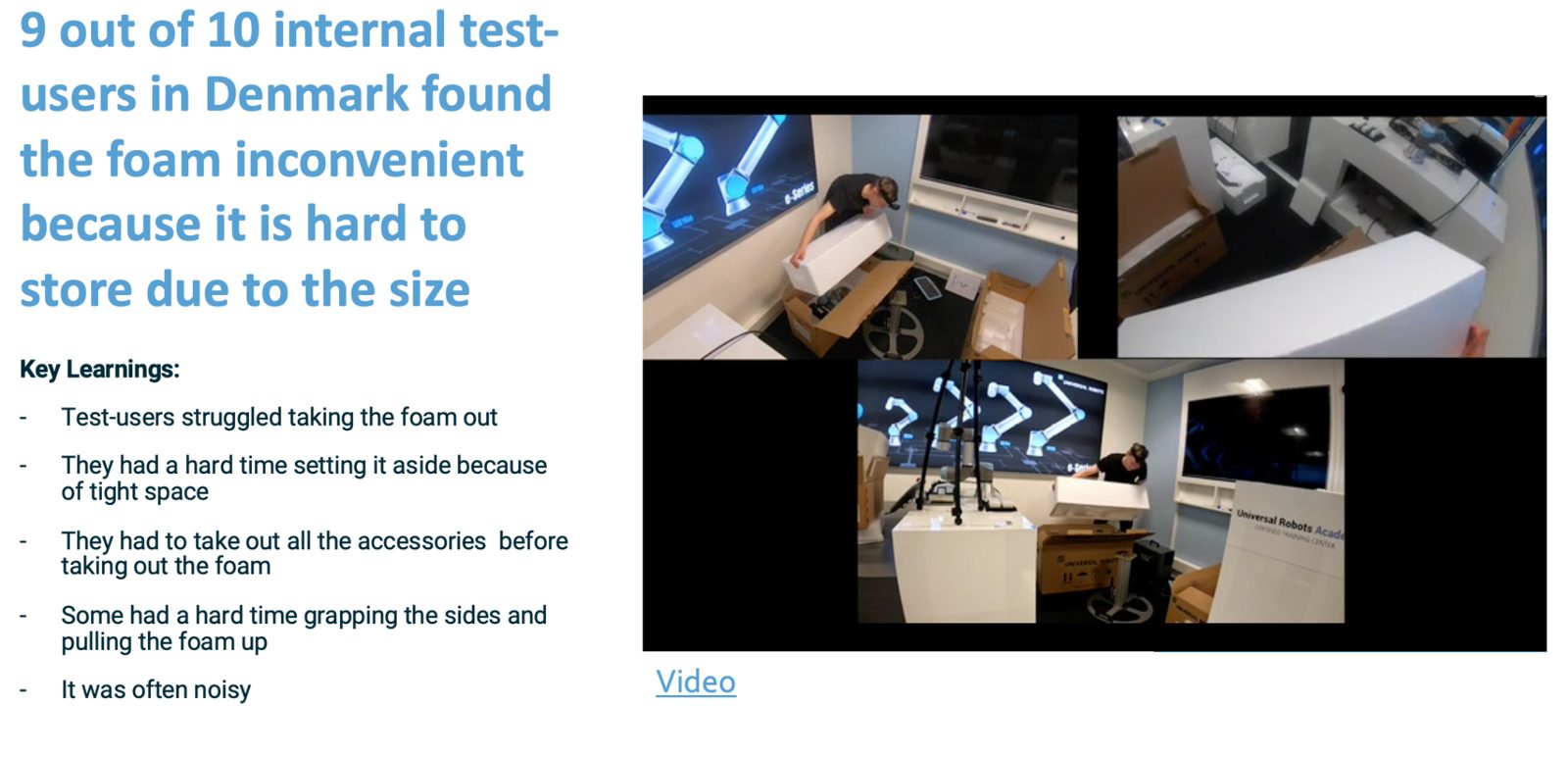
9 of 10 internal test users in Denmark found the foam inconvenient: hard to grip, noisy, every accessory out before the arm, and a storage problem afterwards.
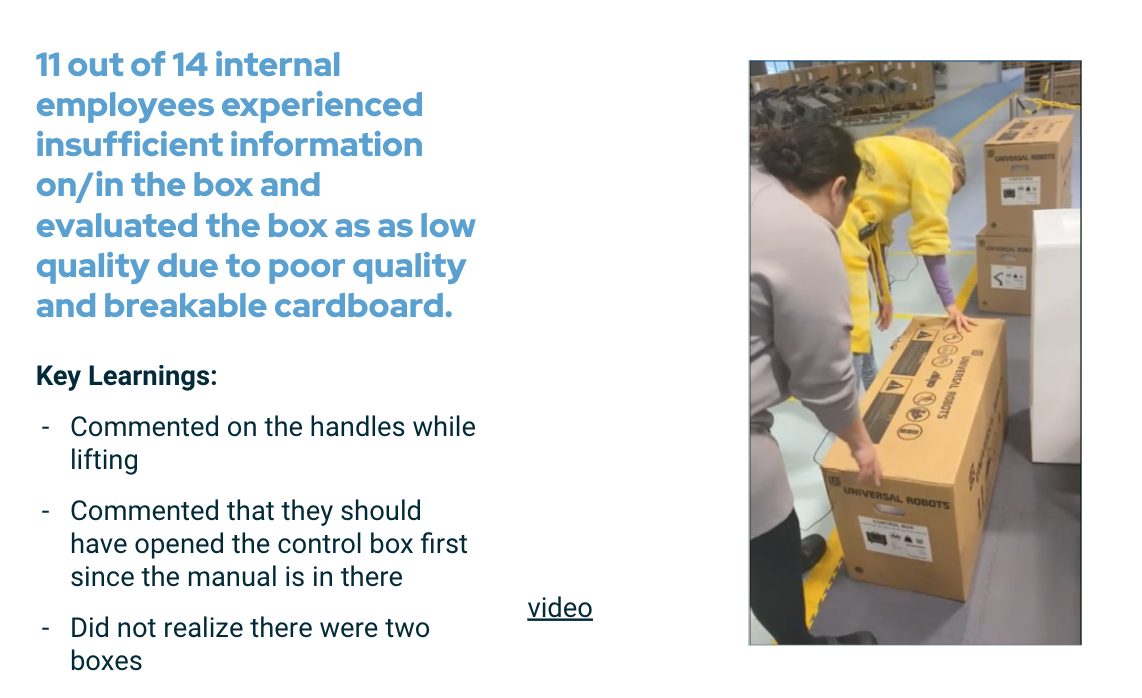
11 of 14 internal employees experienced insufficient information on and in the box and judged it low quality; several did not realise there were two boxes.
Insight cards and journey map from the 2022 unboxing study, shown with the R&D department's approval for public use. Test-user video is internal.
What I’d do differently.
Recruiting real semi-independent customers proved hardest; simulated users covered the knowledge scale but not the mature buyer. Next time I would secure customer visits before the study starts.